Legalizations, Certifications,
Apostilles & more.
Seamless processing of your document legalization. From initial certification to apostille or final legalization at the consulate.

Apply for Documents and Certificates for International Use
We assist in obtaining current documents and certificates such as birth certificates, marriage certificates, police clearance certificates, commercial register excerpts, or corporate documents – including verification of the required format.

Obtain Certifications for Your Documents
We check which certification steps are required for your document – from official or notarized certification, through preliminary and final certification, to apostille or legalization.

Apply for an Apostille for Your Documents
For many countries, an apostille confirms the authenticity of German certificates and documents. We check whether an apostille is sufficient and handle the application process for you. For contracting states of the Hague Convention.
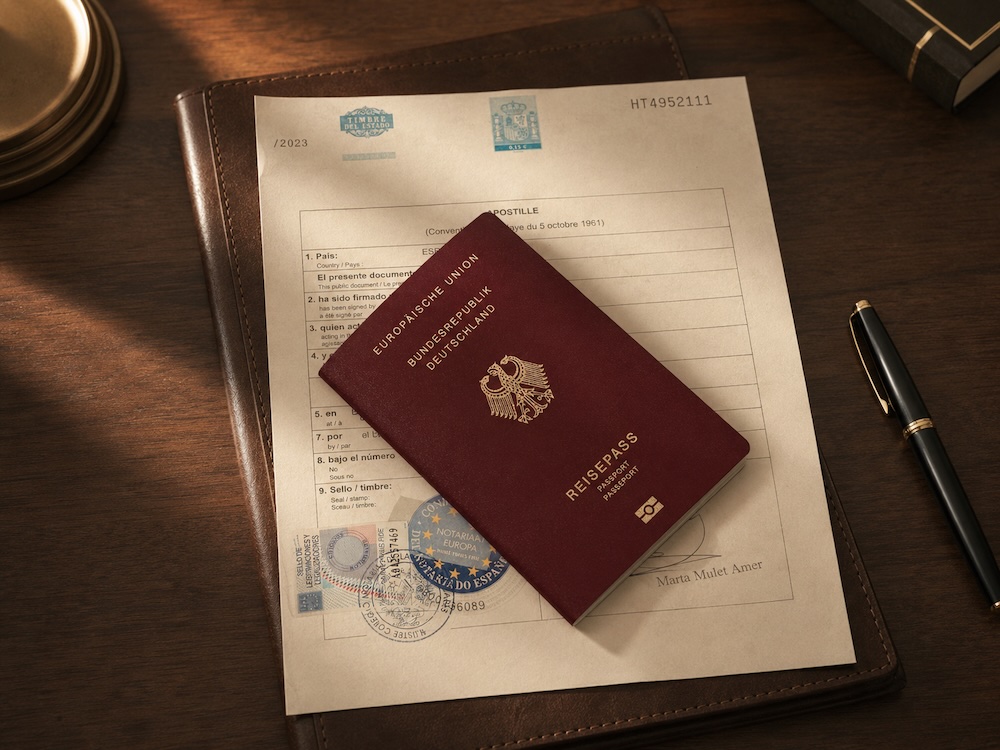
Consular Legalization for the Recognition of Your Documents Abroad
If an apostille is not sufficient, consular legalization is often required. We coordinate the necessary preliminary steps and submission to the relevant consulate.

Certified Translations for Authorities and Consulates
Many foreign authorities require certified translations of certificates, diplomas, or corporate documents. We coordinate sworn translations tailored to the specific procedure.

DOCUMENTS
LEGALIZED
YEARS IN
THE MARKET
YEARS
OF EXPERIENCE
.
German documents are not automatically recognized abroad. Depending on the destination country, document type, and purpose of use, an apostille, consular legalization, notarized or official certification, or a certified translation may be required. visumPOINT checks country-specific requirements, coordinates with the relevant authorities, and manages the entire document process – from procurement to final authentication. This ensures your documents are in the format that is actually accepted in the destination country.

Review documents
You provide the document type, destination country, and purpose of use. We check which form of authentication or legalization is required.

Define procedure
We determine whether document procurement, official or notarized certification, preliminary and final authentication, apostille, legalization, or translation is required.

Unterlagen vorbereiten
We check originals, copies, validity, formal requirements, and country-specific requirements before the authentication process begins.

Behörden koordinieren
We handle coordination with registry offices, notaries, regional courts, district governments, the Federal Foreign Office (BfAA), translators, or consulates.

Dokumente bereitstellen
Upon completion, you will receive your apostilled or legalized documents back – ready for use in the destination country.
Certify documents.

Birth Certificates
For visas, marriages, or inheritances, international birth certificates are required, which are often only recognized abroad with an apostille or legalization.

Marriage Certificates
International marriage certificates are often required in certified form for visa applications for family reunification, name changes, the birth of a child, and for administrative matters outside the EU.

Certificates & Diplomas
Academic and professional qualifications often need to be translated and apostilled or legalized for work permits, recognition procedures, or international assignments.

Police Clearance Certificates
For work visas, residence permits, or administrative procedures abroad, special police clearance certificates for use abroad are required. For authentication, depending on the destination country, with an apostille or legalization.

Commercial Register Extracts
For company formations, tenders, banking processes, or international business transactions, commercial register extracts are often required in certified form.

Powers of Attorney
Powers of Attorney must, depending on the destination country, be notarized, further certified, apostilled, or consularly legalized.

Articles of Association
For international business transactions, branches, or official registrations, many countries require certified corporate documents.

Certification Chain
From certified translation to notarization, pre-certification, apostille, and legalization: the correct order of steps is crucial.

Frequently Asked Questions.
An apostille or legalization is required when a German document needs to be officially recognized abroad – for example, for a visa, a work permit, a marriage, family reunification, company formation, or an administrative procedure. Frequently affected documents include birth certificates, marriage certificates, police clearance certificates, academic certificates, commercial register extracts, powers of attorney, or articles of association. The correct procedure always depends on the destination country, document type, and purpose of use.
Civil status documents such as birth certificates, marriage certificates, or certificates of no impediment to marriage are frequently certified, apostilled, or legalized. Police clearance certificates, school and university certificates, employment references, and corporate documents like commercial register extracts, powers of attorney, and articles of association are also among the typical documents. Depending on the destination country, certified translations, notarial certifications, pre-certifications, or final certifications may also be required.
In most countries, either the original diploma certificate or a duplicate copy issued by the university is required. Depending on the federal state, this is first certified by the district government or the Ministry of Science.
Depending on the destination country, a certified translation may also be necessary. Furthermore, depending on the country of use, additional steps such as confirmation by the Federal Foreign Office or consular legalization by the respective foreign representation are required.We handle this entire process for you, reliably guiding you from the application for the necessary documents to the complete final legalization by the competent consulate.
A certificate of good conduct is issued as an original document by the competent authority. However, for use abroad, a special certificate of good conduct for use abroad and an additional certification are required.
Depending on the destination country, the certificate of good conduct will either be confirmed with an apostille (according to the Hague Apostille Convention) or through consular legalization at the relevant foreign representation. In some cases, a certified translation is also necessary.
We support you throughout this entire process – from checking country-specific requirements to applying for the apostille or consular legalization.
The apostille is the simplified procedure for countries that recognize the Hague Apostille Convention. For other countries, consular legalization is usually required. This involves preparing the document through several stages and then having it confirmed by the embassy or consulate of the destination country. visumPOINT checks in advance whether an apostille is sufficient or if full legalization is necessary.
The process often seems simpler than it is. Responsibilities differ depending on the federal state, document, and destination country. Some documents need to be re-applied for, notarized, pre-certified, finally certified, translated, or submitted to the consulate. A wrong stamp, a missing intermediate step, or an outdated document can lead to the rejection of your papers. visumPOINT verifies the correct procedure, coordinates with the involved authorities, and ensures that your documents are in the format accepted in the destination country.
To obtain a certified birth certificate for use abroad, you first need to apply for a current birth certificate. Civil status documents must always be presented in their original form and must not be older than six months. Applying for an international birth certificate is particularly recommended, as it is issued in multiple languages and often eliminates the need for an additional translation. The next step involves the certification of the document by the competent superior authority, which varies depending on the federal state – such as the district government (Bezirksregierung), the regional council (Regierungspräsidium), or the state administration (Landesverwaltung).
Depending on the destination country, the document will either be provided with an apostille or finally certified through consular legalization by the relevant foreign representation. We are happy to take over this entire process for you – from applying for the current birth certificate and all necessary certifications to obtaining the apostille or consular legalization, as well as, if required, the certified translation.
Do you have a specific request?
Contact us anytime. We go the extra mile for you.
No matter your requirements, we personally ensure you reach your goal safely. Get in touch now.